Percy remembers everything you say. So you don't have to.
Tell Percy what you see. Ask Percy what happened. Tell Percy what's next. Your garden's past, present, and future. All in one place, all handled for you.

Gardening should feel like gardening.
Every garden tool ever made asks the same thing of you: Log the planting. Update the calendar. Check the dashboard. The existing tools take something you love and quietly infuse it with all the richness and joy of timesheets.
Percy was built on a different philosophy: the tool should do the work, so you can enjoy the garden.
The most important thing Percy can do is get out of the way. So it does.
Just hold a button. Say something about those marigolds. And keep going.
Percy handles everything you’d expect a great garden tool to handle: what you planted, what you harvested, what went wrong, what you’re planning next. It just does it from a sentence instead of a form. And it remembers all of it, across seasons, in a way no notebook or spreadsheet ever could.
But that’s just the starting point. Because Percy also captures the things you notice on the way. The first bloom. The bees all over the echinacea. The way a July evening smells after rain. The stuff that no garden tool has ever had a place for, but that makes a season feel like a season.
And when you do want to revisit your memories, whether that’s mid-summer or curled up with a seed catalog in January, they shouldn’t feel like visiting a spreadsheet. They should feel like a portrait of your season. As alive and vibrant as your garden itself.
Four things. No spreadsheets.
Tell
Percy is voice-first because gardens are a hands-dirty, phone-in-your-back-pocket kind of thing. When you notice something, a first bloom, a ripe tomato, an especially cute bumblebee, you hold the button like a walkie-talkie and say what you see. That's it. No navigating to a screen or locating your zucchini in a mile-long drop-down menu.
Just say whatever comes naturally:
- “The roses are going absolutely nuts right now.”
- “Something’s eating the basil. Little holes all over the leaves.”
- “Pulled the garlic today. Biggest bulbs I’ve ever grown.”
- “The dahlias are unbelievable this year.”
You don’t need the right terminology. You’re allowed to say “um.” Percy uses AI to figure out the plant, the observation, the action or issue and plays it back for confirmation.
You said: “The strawberries are ripening like crazy. Picking a handful every morning now.”
Percy responds: “Got it. Strawberries, harvesting daily. That’s exciting. Sound right?”
If you want to add a photo of the garlic actually in your hand or the hole in the basil leaf that is definitely the work of something with opinions, there’s a prompt to attach one before you confirm. Tap “That’s right” and you’re done. The whole thing takes ten seconds. Then you’re back to enjoying your garden.
Behind the scenes, Percy also captures the actual weather conditions at that moment: temperature, humidity, wind, precipitation. You’ll never have to think about it. But your garden’s history will be richer for it in ways that start to matter a lot by season two.
Just hold the button like a walkie-talkie.
Ask
This is the part that changes everything.
Percy doesn’t just store your notes in a list. Percy builds a living picture of your garden that you can have a conversation with. Three weeks into your first season, you’ll ask something you’ve already forgotten, and Percy will know.
- “When did I plant the cucumbers?”
- “Which tomatoes did I say were worth growing again?”
- “How did the garlic do in the grow bag by the patio?”
- “Did the slugs prefer the lager or the pilsner?”
You can also show Percy what you’re looking at. Snap a photo of a plant you don’t recognize, a leaf that looks wrong, or whatever’s been chewing on everything, and ask what it is. Percy identifies the plant, the pest, or the disease from the image. And because Percy already knows your garden, the answer isn’t just a species name. It’s the kind of thing a knowledgeable friend would say: “That’s powdery mildew. You had it on the squash last year and the milk spray worked after two applications. Same bed, same time of year.”
Every identification Percy makes becomes part of your garden’s memory. Identify cabbage looper caterpillars in July, and next July, Percy already knows they’re coming. It knows what they look like, what they ate last time, and what you did about it. The photo you took to solve a problem today becomes the early warning system that prevents it next year.
Percy’s AI can also answer general gardening questions. The kind you’d otherwise Google at 2am. When it does, it draws on what it knows about your specific garden. Your beds, your soil, your slugs. So it’s not generic gardening advice for Zone 7B. It’s gardening advice based on what’s happened in your actual garden.
No other gardening tool does this. Not a notebook accidentally left out in the rain. Not a spreadsheet. Not the note on your phone that just says “honeynut squash???”
Plan
Percy also holds your intentions, which are historically the things most likely to evaporate between the garden and the kitchen. Just say what you’re planning like you’d say it to a friend.
Say whatever comes naturally:
- “Remind me to fertilize these in two weeks.”
- “I should start the next round of lettuce before this batch bolts.”
- “I want to try dahlias from tubers next spring.”
During onboarding, Percy asks what you’re carrying into this season — a variety you loved, something that didn’t work, a question you want answered. These become the seeds of your garden’s memory.
Percy surfaces a reminder card when the time is right. Not a push notification at 7am on a Saturday. A quiet card that says, “You wanted to do this. Ready?”
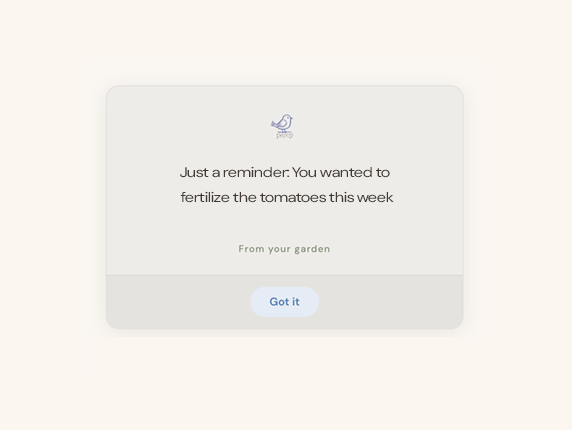
This is how succession planting becomes something you actually do, rather than something you describe at dinner as something you’re going to do.
Return
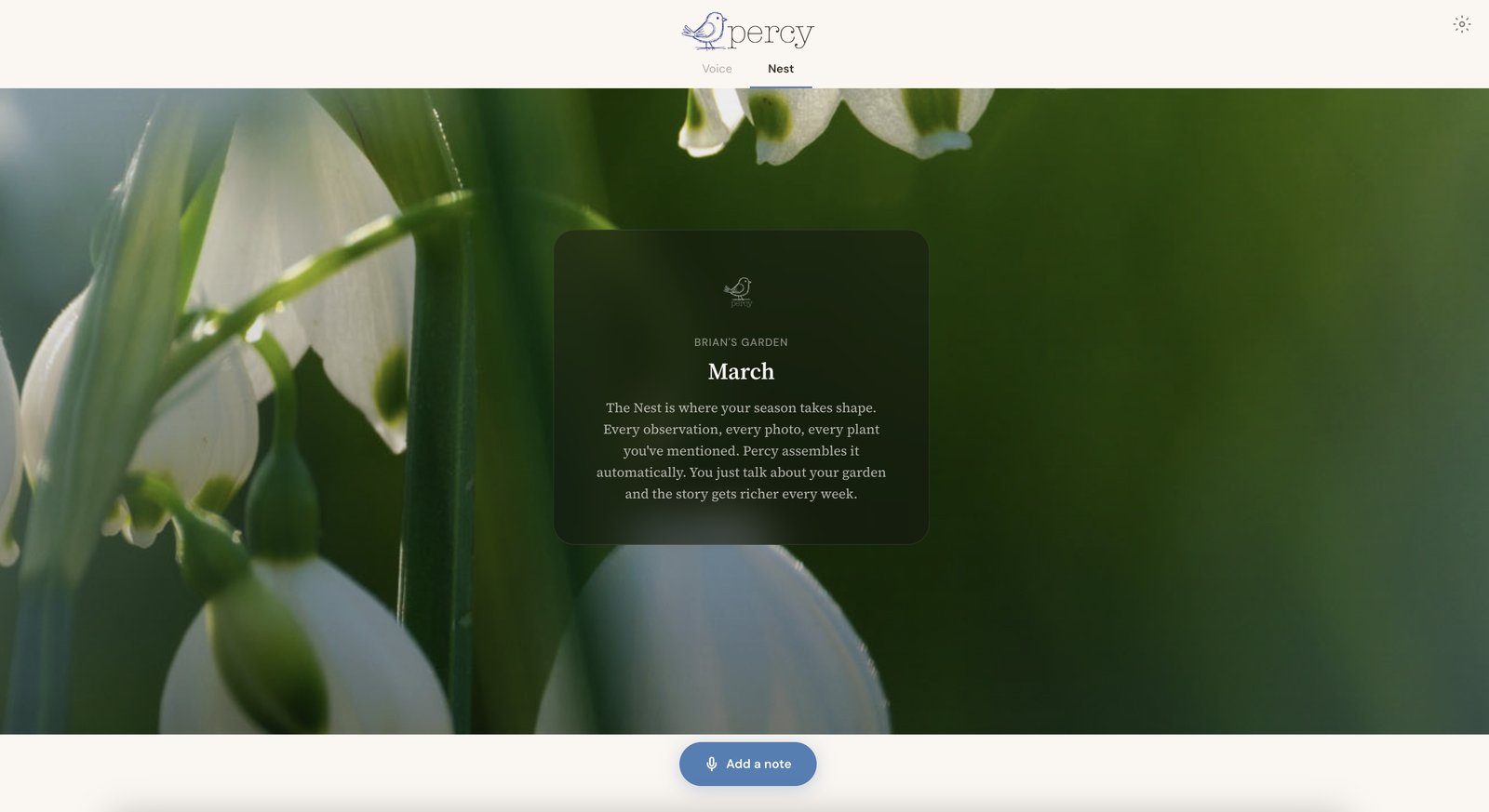
While you’re out in the garden telling Percy things, the Nest is quietly building a record of your season. Something you’d never have the patience to make yourself, which is not a criticism, just an accurate assessment of how gardening seasons go.
The Nest is Percy’s visual view: a living, scrollable portrait of your garden as it’s happening. Your highlights are at the top, with photos and botanical illustrations woven through.
A single photo feels modest in the moment. Across a season, you log twelve tomato entries with photos and you’re watching fruit go from green to gold. That’s not a feature. That’s the reason someone opens Percy in December when the garden is asleep, just to remember what summer felt like.
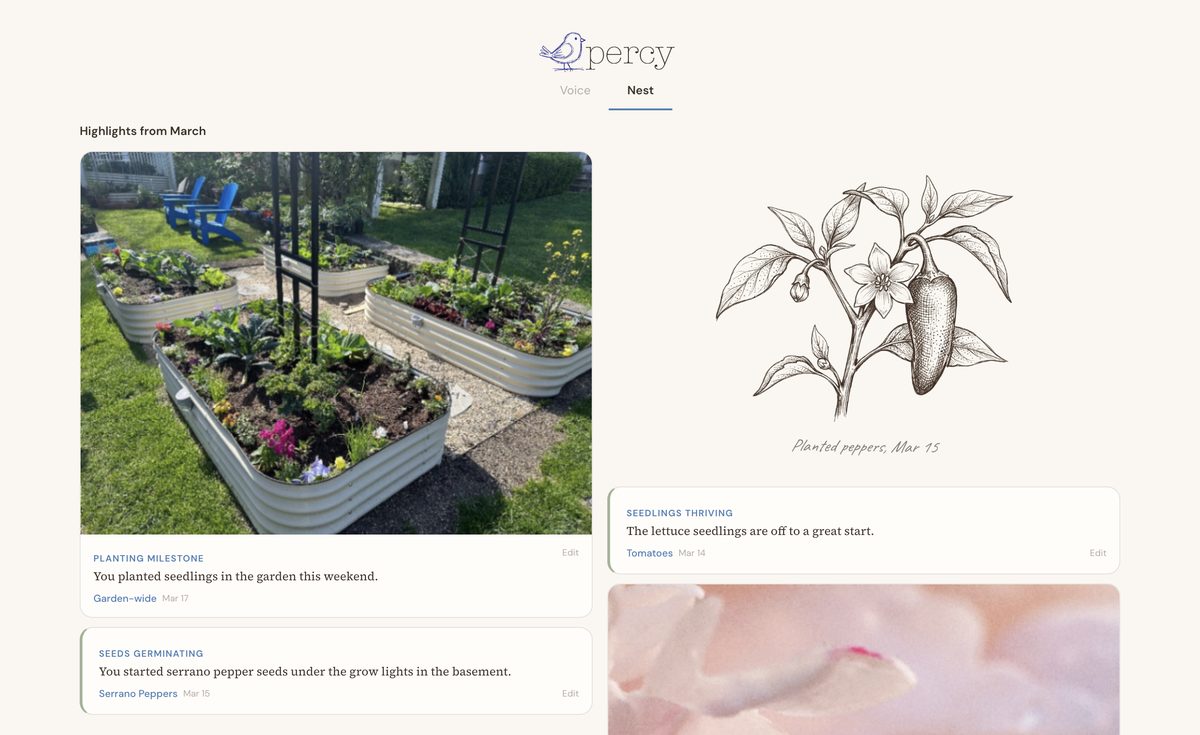
Below that is your full plant roster. It captures every plant and varietal you’ve mentioned, with its full observation history, organized and waiting.
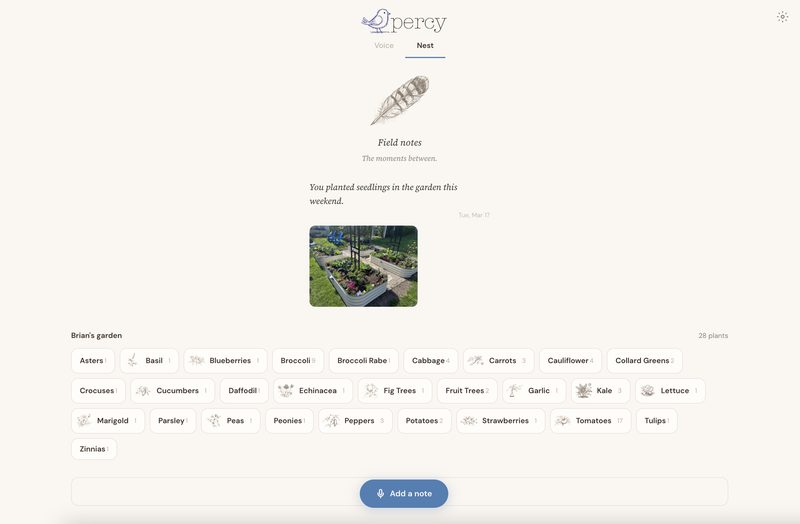
Tap any plant to see its full story. Every observation, every varietal, every note — organized by date and filterable by type. The kind of record you’d never build yourself, assembled automatically while you were out there gardening.
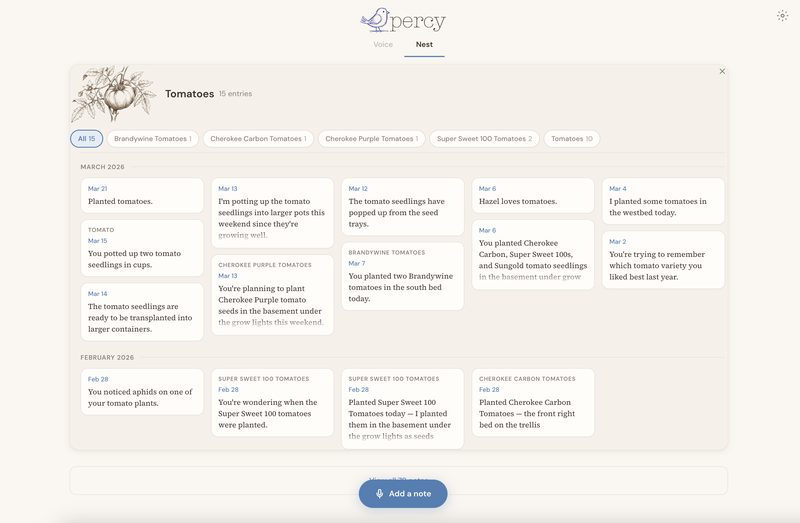
You just talk about your garden, and Percy builds the Nest. It gets richer every week. By mid-season it becomes the kind of thing you open for no particular reason, just to see what’s there.
Here’s how it plays out, spring to winter.
Early Spring
You’re flipping through seed catalogs or standing in front of empty beds trying to remember what went where last year.
You ask Percy. Percy tells you: the cherry tomatoes were incredible in the west bed, the lettuce bolted embarrassingly fast in the south bed, and at some point in September you announced you were going to grow more daffodils. Percy took that seriously even if you didn’t.
Once you’ve been using Percy for more than one season, it starts coming to you with timely information. “Last year you started tomato seeds indoors around March 12th. Planning to do the same?” Not generic zone information. A memory based on what you actually did, in your actual garden, last year.
And because Percy has been quietly tracking the weather alongside every observation, it knows things you’d never think to look up. What the temperature was the week your seedlings went in. Whether that late cold snap last April actually affected anything. Your garden’s weather history, correlated with what actually happened in the beds. No gardener has ever had that before.
Planting Season
As you start putting things in the ground, you tell Percy what’s going where.
- “Roma tomatoes in the west bed. Cherokee Purples along the fence.”
- “Started cucumber seeds today.”
- “Transplanted the dahlias. Fingers crossed.”
Each one takes a few seconds. Percy files it. You keep gardening.
Mid-Season
Everything is happening at once, which is the precise moment most gardeners stop writing anything down because the garden is incredible and overwhelming and also there’s a hornworm situation. You start noticing more because you know nothing’s going to slip through the cracks.
- “The echinacea is blooming and the bees are all over it.”
- “Squash leaves are looking powdery.”
- “Picked the first cucumbers today. Way earlier than last year.”
- “I hate hornworms.”
- “What is this thing on my tomato leaves? [photo attached]”
A week later, you mention the powdery mildew again. Percy notices:
Percy
“You’ve brought up powdery mildew on the squash twice now. Last year you tried milk spray and it worked after two applications. Want to try that again?”
The first time this happens it feels slightly uncanny. Percy remembered the milk spray. You had forgotten about the milk spray. You had, if we’re being honest, also half-forgotten the squash.
And when you can’t identify something at all, you don’t have to. Snap a photo, ask Percy, and it tells you what it’s seeing. Not a generic field guide match. An answer that factors in your garden, your location, and what’s happened before. The identification gets saved like any other observation, which means Percy isn’t just solving today’s problem. It’s building the record that catches the pattern next year.
Meanwhile, when a heat wave is headed your way, Percy gives you a heads-up: “Temperatures above 95 forecast this Thursday through Saturday. Your tomatoes might appreciate some afternoon shade.” Not because Percy checked a generic weather app. Because Percy knows what you have in the ground and what the forecast means for it.
Percy captures all of it. The wins and the problems. The things you’d celebrate and the things you’d troubleshoot. Nothing gets lost because you forgot to write it down later.
By your second season, Percy starts reaching out on its own: “Heads up. Last year cabbage worms showed up the first week of June. Might be worth adding row cover this week.” Which is either very reassuring or a little ominous, depending on your relationship to very hungry caterpillars.
Harvest
The best part. You tell Percy what you’re picking and how things turned out.
- “The Brandywines are the best tomatoes I’ve ever grown. Unreal flavor.”
- “Pulled the garlic. Small bulbs. Probably planted too late.”
- “Zinnias are stunning this year. Cutting bouquets every week.”
In Percy’s hands, er, wings, these moments become next year’s starting point. When you’re choosing varieties next spring:
Percy
“Last year you said the Brandywines were the best you’d ever grown. Want to plant them again?”
Your own enthusiasm, returned at exactly the moment it’s useful, instead of lost somewhere in a notebook that was accidentally recycled along with three years of tax documents. Oops.
End of Season: Your Migration Report
When the season winds down, Percy creates your Migration Report. A beautiful year-in-review of everything that happened in your garden. Your most-mentioned plants. Your seasonal timeline. The challenges, the victories, the varieties worth growing again and the ones we shall never speak of again. Your garden’s annual story, assembled automatically from a season of small moments you narrated while standing in the sunshine.
You don’t do anything to make this happen. Percy has been building it since spring.
Your first Migration Report is part of your free season. It becomes your planning document for next year, except you didn’t have to write any of it. Starting in year two, it includes side-by-side comparisons with last season: what improved, what patterns emerged, what you learned.
That’s when it gets really fun. Those hornworms will never know what hit ’em.
Migration Report coming this winter.

The longer you use it, the more valuable it gets.
Percy is useful from your first week. But the longer you use it, the more extraordinary it becomes. Here’s how that plays out.
Year One: Percy learns your garden.
Your first season, Percy captures your observations, answers your questions, remembers your plans, and produces your first Migration Report. Three weeks in, you’ll ask something you’ve already forgotten and Percy will know the answer. You’ll start to wish you’d also mentioned where you left your keys.
Something else tends to happen in year one: you start noticing more. Not because Percy is watching you (though once you’ve thought about it that way, it’s hard to unthink), but because you know something is catching what you say. The way light hits the back bed in late afternoon. Which flowers the pollinators actually prefer. When the first fireflies show up. You start narrating things you’d normally walk past. This turns out to be its own reward. It also bewilders the neighbors, which turns out to be its own reward too.
Every observation is also silently building something else: a weather-correlated history of your garden. You won’t think about it much in year one. But every note you make is tagged with the actual conditions at that moment. That data is accumulating.
Year Two: Percy connects the dots.
With a full season of your observations, Percy starts doing two things: answering questions with real depth, and coming to you unprompted.
“Your Sungolds ripened July 2nd last year. Keep an eye on them.”
“The dahlias didn’t make it through winter in the north bed, but they came back strong in the raised bed.”
“Last year you side-dressed the tomatoes with compost in late May. It was your best tomato year.”
Not generic zone advice. Advice from your actual garden’s actual own history, delivered when it’s actually useful.
And now the weather data starts to matter. Percy can correlate what happened in your garden with the conditions that produced it. It knows your tomatoes dropped blossoms during that 94-degree week last July. It knows your best garlic year started with a cool, wet April. It knows your first frost came October 3rd, not when the almanac predicted. No gardener has ever been able to make these connections across a full season of observations and actual weather data. Percy does it automatically.
Your second Migration Report shows side-by-side comparisons: what changed, what improved, what patterns are emerging across seasons. Your garden has never been this well understood.
Year Three and beyond: Percy knows your garden better than you do.
Multiple seasons in, Percy can spot trends you’d never catch on your own. Which beds produce the best of which crops. When your specific microclimate tends to get its first frost. Which varieties keep coming back because they simply work in your patch of land.
By now, Percy isn’t just remembering. Percy is anticipating.
“Your basil has bolted in early July three years running. Succession planting in late June might buy you a few more weeks.”
“Peppers consistently do better in your east bed. Probably the morning sun and wind protection.”
“Your best tomato harvests correlate with the seasons you had consistent rain in June. This June has been dry. Might be time to water more deeply.”
These aren’t guesses. These are patterns from your garden, across years, connected to the actual weather that shaped each season. No tool, no notebook, no memory could do this. It’s the kind of garden intelligence that simply didn’t exist before.
That’s not a better garden app. That’s something that has never existed before.
If you really want to geek out.
Percy works beautifully with nothing but your voice. But if you want to give it more to work with, it’ll use every bit of it.
Everything below is optional. None of it is required. But each thing you share makes Percy’s understanding of your garden more specific, more useful, and, honestly, more interesting.
Your location
Percy looks up your hardiness zone, your average frost dates, and your growing season length. This is how it knows when to nudge you about frost cover and when to stop mentioning it.
Your garden address
Tell Percy where your garden is and it estimates how much daylight each of your beds gets through the seasons, then folds in the sun or shade exposure you’ve described for each area. The bed you’ve called “full sun” gets more usable hours in June than in March, and Percy adjusts its suggestions accordingly.
Your soil
Tell Percy what you’re working with. Heavy clay, sandy loam, acidic, amended, whatever you know. It factors this into every recommendation. “Plant dahlias” becomes “plant dahlias, and in your clay, amend with compost first.”
Your garden layout
Upload a rough sketch, a few photos, or just describe it. Percy maps your growing areas, figures out what’s near what, and connects every future observation to a specific place. “The tomatoes are struggling” becomes “the tomatoes in the south bed are getting cooked by afternoon sun. Try the bed along the fence next year. It gets some shade after two.”
Your history (coming soon)
Import previous seasons from a spreadsheet, a notes app, screenshots, or photographs of your handwritten journal. If you’ve been using another garden planning app, Percy can read that export too. It pulls out the observations and builds a searchable record of years you already lived through. Your first Migration Report can compare seasons you tracked on paper against the one you’re tracking now.
None of this is homework. Percy never asks you to fill out a form. It notices when more context would help and mentions it. The more you give it, the better it gets. But it starts being useful the moment you say your first sentence.

Percy is for gardeners who’d rather be gardening.
Your garden has always had a story. Percy is the first thing that’s ever been able to tell it.
Free this season · $39/year after · No credit card

for iPhone
for Android & desktop